

Shopping the produce section first instead of last helps me to make better choices.
Shopping the produce section first instead of last helps me to make better choices.
The Danger and Sin of Christians Inter-Marrying Outside the Covenant Community
The Apostle Paul teaches in Ephesians 5 that marriage is a redemptive picture of Christ and His Church. When a professing Christian marries an unbeliever, the believer has distorted and lied about the marriage of Christ to His people.
If a Christian woman marries an unbelieving husband, she portrays the image that the Church is united to an unfaithful and unrighteous Savior. When a Christian man takes an unbelieving wife, he portrays Christ as one who does not redeem and sanctify, but one who leaves His Church in a dark and unregenerate state. He depicts His Savior as one who does not save, but allows His bride for whom He died to enter everlasting hell.
Either way, the picture is distorted and Christ is dishonored. Christians must not be unequally yoked.
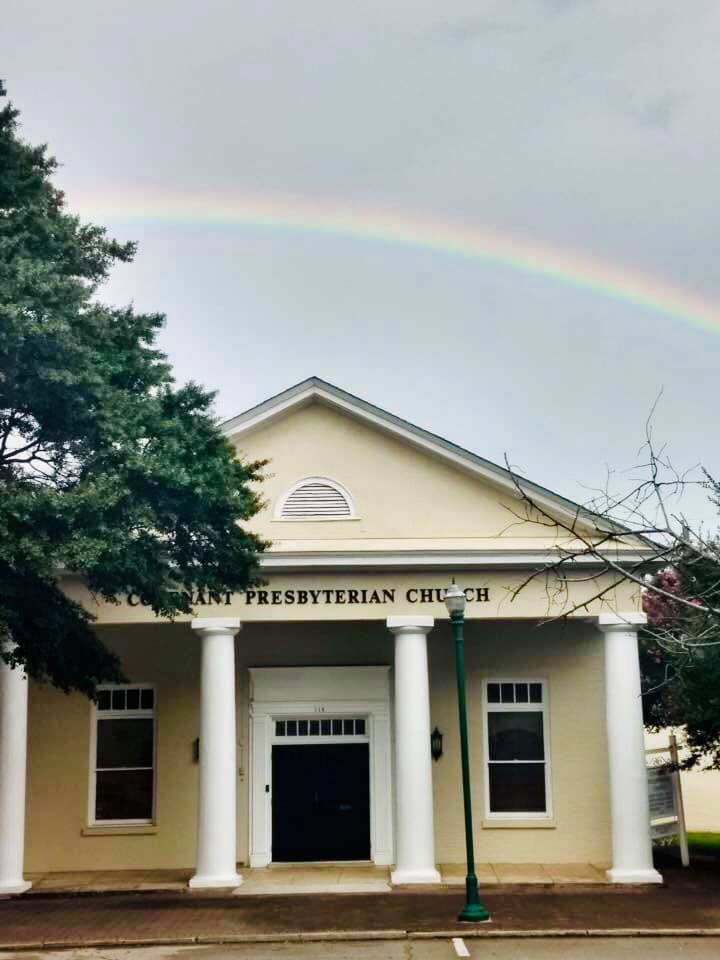
A guest post from Leora Hall, a member from Covenant Presbyterian Church (OPC).
“A symbol of God’s promise made to Noah above our beloved church, Covenant Presbyterian Church (shared by our excellent pastor, A. Boyd Miller IV). Covenant has been our church family for ten years now. I’ve been thinking about how difficult (or impossible) it is to measure what happens when a person or a family roots into a faithful and Bible-believing church. There is no perfect church short of heaven. But nothing replaces the local church in a Christian’s life, and the blessings and power of it are incalculable. I’ve been reflecting on what has kept us grounded as a family over the years, what has kept us faithful to each other and to Christ, what has kept us from absolute despair in dark times, what has uplifted us and provided needed fellowship and accountability throughout the various seasons of our lives. In tandem with the obvious answer of God’s covenant faithfulness, the first thing that came to my mind was being plugged into our local church. Regular Lord’s Day worship. Regular hearing of the preached Word of God. Regular taking of the Lord’s Supper. Regular catechizing of our children. Regular prayer with and for each other as a church body. The Holy Spirit mysteriously and quietly working to center us, convict us of sin, encourage us, tenderize our hearts, point us to our eternal hope and those realities beyond this momentary world, and slowly (or sloooooowly, lol) change us into the likeness of Christ one day at a time. This is what the Lord so graciously provides to His people through the local church. What cause to be grateful and embrace such a gift. Many of our brothers and sisters around the world being imprisoned or martyred for their faith in Christ are literally dying for this privilege that we so often take for granted. If you live in or near LaGrange and haven’t found a church family, then we’d love to have you at Covenant Presbyterian Church! ❤️
“And let us consider how to stir up one another to love and good works, not neglecting to meet together, as is the habit of some, but encouraging one another, and all the more as you see the Day drawing near.” Hebrews 10:24-25
“But as it is, God arranged the members in the body, each one of them, as he chose. If all were a single member, where would the body be? As it is, there are many parts, yet one body. The eye cannot say to the hand, ‘I have no need of you,’ nor again the head to the feet, ‘I have no need of you.’” 1 Corinthians 12:18-21
“Remember the Sabbath Day, to keep it holy.” Exodus 20:8″
What does a Christian woman do if she never marries, despite legitimate aspirations for a husband? What if you have prayed and tried to marry, only to find the door providentially closed? How does the Christian bachelor, with his share of rejections, continue to rejoice in the Lord always? What if you once were married, but tragedy brought an unexpected divorce or widowhood? Now you find yourself alone (maybe with children). Does God really expect you to be content?
Some people do choose singleness, but many times singleness chooses you without your permission. Jesus reminds us that while some are eunuchs for the sake of the kingdom, many remain unmarried as a by-product of the fallen human condition (Matt. 19:12). Congenital disorders, unfaithful spouses, same-sex attraction problems, premature death, war, disease, paucity of like-minded believers, and “bad luck” all complicate and exacerbate the matter. Yet through, above, and against all the secondary causes of singleness, the sovereign hand of God’s providence remains for our good and his ultimate glory.
Yet how do redeemed singles, with faith in Christ, remain content under divine sovereignty, especially when the Scriptures rightly celebrate marriage and refer to it as honorable (Heb. 13:4)? God instituted marriage in the garden and declared it good (Gen. 2:18). Isaiah describes marriage as a picture of God’s grace and redemption (Isa. 62:4–5). Proverbs 18:22 declares that “he who finds a wife finds a good thing and obtains favor from the LORD.” The single woman attends a wedding and hears that marriage is a metaphor of that glorious union between Christ and his people (Eph. 5:31–32), yet then wonders where that picture leaves her. If marriage portrays consummated glory with Christ in heaven, then what does singleness depict? Hell?
The church’s response to such questions could be a series of sermons on contentment at the next singles’ retreat, to which the unmarried rightly drop their heads and think within themselves, “Oh no! Not again!” While contentment is an important Christian fruit, and discontentment is a spiritual malady that affects married and single people alike, the need for contentment is sometimes best addressed consequentially. Rare is the Christian who gains assurance of salvation simply by studying the topic of assurance. Likewise, few singles will find soul-rest merely by burrowing into the subject of contentment. The discontented single may actually become more frustrated. The law’s demand for contentment can produce a rebellious response from us, for discontentment is at work within us (Rom. 7:8, 23). “Wretched (single) that I am! Who will deliver me from this body of death? Thanks be to God through Jesus Christ our Lord!” (Rom. 7:24-25).
Therefore, when applying the tenth commandment, the church should direct her unmarried members to Christ, who willingly became single for us, that we (the church) might become married to him. In the fullness of time, the eternal Son of God became a single man, born under the commandment not to covet, and fulfilled that law with a life of sinless contentment. Now those who believe in him have a pardon for their discontentment and the graces necessary to endure suffering for him. When tempted to kick at the goads of providence or murmur against the unmarried condition, the gospel gives us many soothing glances at our beloved Jesus. Our Lord Jesus Christ provides us with delight in his person, work, fellowship, and promises. He assures us that, as the single believer increasingly treasures him, she also finds moments of peace in accordance with the law.
If the Father has not withheld his only Son, will he not also give me all things for this single life and eternity (Rom. 8:32)? Indeed, he does. The Lord graciously gives the single Christian his Spirit to comfort, console, and sanctify (Rom. 8:15–17). The Lord also provides us with his church as our new family in Christ, where we find many mothers, fathers, brothers, and sisters in the household of God (Matt. 12:50).
Thus, singles would do well to immerse themselves deeply within the life of the local congregation. Hospitality, visitation, fellowship, prayer meetings, and Lord’s Day worship provide wonderful avenues of blessing to those who find themselves without a spouse. I cannot imagine the single life without the loving fellowship of my local congregation. But, unwisely, some singles abstain from the full fellowship of God’s people and limit their blessings by remaining peripheral in the body-life of the congregation.
Yet even with the help of the church and the regular means of grace, the process of obtaining sanctified contentment in Jesus alone can still be, for the single Christian, a terrible battle of the soul, with setbacks, fits, sighs, tears, discouragements, and even rebellious outbursts—if only privately. Still, by God’s grace and through persevering effort, the child of God can find rest in the will of her heavenly Father. The apostle Paul, who himself was single, provides encouragement for the unmarried by noting that he himself had to learn the secret of contentment (Phil. 4:11). Paul was not born content, nor was his discontentment eradicated at conversion. Contentment is not a lesson easily or superficially mastered; rather, it is comparable to the battle of a strong-willed child weaned late from his mother (Ps. 131:2). Also, Paul did not write about contentment from a Mediterranean spa, but rather from a dark, damp, rat-infested Roman prison, with fresh wounds from corporal punishment.
How then did Paul learn this contentment? Like his Lord, he learned contentment through the things he suffered (Heb. 5:8). The apostle admits to the Corinthians that while under Satanic attack, he prayed three times for deliverance. Yet the Lord denied his requests and told him, “My grace is sufficient for you, for my power is made perfect in weakness” (2 Cor. 12:8–9). Singleness may be one of those afflictions tailored to you, but his grace is perfected in your weakness. The single Christian who suffers weakness through unrealized marital aspirations and the disappointments of unanswered prayer may yet find grace at work through the unhappiness.
I have a few final admonitions for my fellow singles: We need perspective as singles. In view of my sins, who am I to complain about my sufferings (Lam. 3:39)? We must take care to have no other gods before us. Marriage is not a god to be served, but a vehicle to glorify him. Singleness strengthens my empathy for others. Knowing loneliness, rejection, and alienation, we serve others who are deeply affected by a broken world. We look upon the homebound, the divorced, and the fatherless with compassion, as those who often view life ourselves from the outside.
Count it a privilege to serve as a single. Singleness can be a great blessing. Biblical and ecclesiastical history is replete with famous and eminently useful singles. Our minds are not divided between pleasing a spouse and pleasing the Lord (1 Cor. 7:32–34). During a season of trial for the church, Paul actually recommended that singles and widows not marry (1 Cor. 7:26–27). We do not know what a day may bring (Prov. 27:1). Distress and persecution by perverse and wicked men may visit the church in our nation and that may make singles an even greater asset to God’s people.
Finally, as a single man or woman, do not say in your heart, “I am a dry tree.” Rather, remember the Lord’s promise that those who love him by keeping his sabbaths and covenant shall receive an eternal inheritance from the Lord that is better than children (Isa. 56:3–5). The present sufferings of singleness are not to be compared with the glory to come (Rom. 8:18). Our inheritance is eternal in the heavens as we travel to a perfect world where there is no marrying or giving in marriage (Matt. 22:30).
A. Boyd Miller, IV is the Pastor of Covenant Presbyterian Church (OPC) in LaGrange. This was first Published in New Horizons, January 2016.

(First Published in The HillTop News, the student newspaper of LaGrange College in May 2012)
Committed to its relationship with the United Methodist Church, LaGrange College’s mission statement calls the school to challenge the minds and inspire the souls of her students. Yet how do we meet the dual demands of expanding minds and souls within one institution? What does Athens have to do with Jerusalem? What does the classroom have to do with Christ?
Writing for students in his realm almost three thousand years ago, King Solomon explains the way of intellectual and spiritual development when he states, “The fear of the LORD is the beginning of knowledge” (Proverbs 1:7a). For Solomon, a sound pedagogical philosophy begins with faith (i.e. fear) in the living God. Note that faith precedes understanding for Solomon. Augustine later answered similarly, Credo ut intelligam, “I believe in order that I may understand.”
Augustine, of course, drew his view of faith preceding reason from the Apostle Paul who states that Jesus Christ is the image of the invisible God (Colossians 1:15). All things were created by Him in the beginning (1:16). Thus, in all the disciplines of the liberal arts, (math, science, history, literature, arts, music, etc.), Christ is Lord who holds all academic subjects together as a part of His creation (1:17).
Thus, the Bible teaches and Augustine affirmed that faith in Christ must precede understanding because faith in Christ as Creator, Sustainer, and Governor provides the only firm foundation for intellectual development with ultimate significance and meaning. The unbelieving scholar who rejects Christ has no firm foundation for his worldview and builds his intellectual life on the sinking sands of his own autonomy (Matthew 7:24). Education without Christ crumbles in significance to a mere heap of utility. Knowledge becomes vain without Truth. Yet, even in the supposed intellectual self-sufficiency of the unbeliever, the skeptic scholar must steal from God and the Christian worldview in order to proceed in his intellectual pursuits, for the universe belongs to God and all it contains. It declares the truth about Him.
However, the Christian scholar, scientist, philosopher, artist is unleashed to study the universe to the glory of God with abandon. Every academic discipline becomes a means to study and glorify the Creator. The heavens explored in science tell of the glory of God (Psalm 19:1). Mathematical equations reveal His creative genius. History understood as the revelation of God’s Providence now has a telos. Literature, art and music seek to imitate the beauty, truth, and complexity of the original Author. Indeed, what makes academics so exciting for the Christian is that all thoughts, disciplines, and subjects are to be taken captive and made obedient unto Christ (II Corinthians 10:5). Thus, there is nothing irrelevant in God’s universe, for it all points to Him. Even the mundane matters of eating and drinking are done to the glory of God (I Corinthians 10:31).
And while God’s common grace ordains that many unregenerate persons make important discoveries in His creation even to the betterment of humanity, man without Christ suppresses the rightful conclusion of that discovered truth that there is one God over all. Original sin within the scholar apart from regeneration creates a bias and blindness against the Creator (Romans 1:18). Thus as Paul states, “Professing to be wise, they became fools,” filled with absurd notions, idolatry, and immorality. This foolishness is not without consequence. We reap what we sow intellectually. General revelation needs the light of special revelation, even as general revelation provides tools for the better understanding of special revelation.
General revelation and special revelation are not competitors, but complementary partners that declare the glory of God to both the mind and the soul. We say with the Psalmist, “In Thy light, we see light” (Psalm 36:9b), which means that in the light of God’s word, we understand the truth of God’s general revelation in creation more clearly. If we are to follow our college mission statement faithfully, we must begin with faith in God, Jesus Christ His Son, and the Holy Spirit’s inspired word, the Bible. And when a student grabs this truth, the mind and soul will be stimulated, liberated, and enlightened.
A. Boyd Miller, IV has been campus minister for Reformation! at LaGrange College for the past sixteen years and is Pastor of Covenant Presbyterian Church (OPC) in LaGrange.
 ADELBERT INK.