

Elements of the Pastoral Visit

Occasionally, visitors or new members at Covenant Presbyterian Church (OPC) are not familiar with the practice of an annual pastoral visit. Much like seeing the dentist or doctor for routine check-ups, the annual pastoral home-visit seeks to promote the spiritual well-being of our members. So, what happens at a pastoral visit?

· Share a Meal Together: I usually like to eat with the family before the official visit. Dinner together provides a time of general socializing and fun before we get to the earnest business of the visit. The pastor can observe family dynamics and catch the latest family news about school, extra-curricular activities, upcoming events, etc.

· Prayer: The pastoral visit is not a mere social occasion, but a means of edification and blessing, which requires the Presence of the Holy Spirit to help. Start with prayer. Some families need exposure to the practice of family worship too. Singing a psalm or hymn together may help them see that they can do it.

· Biblical and Theological Review: I always begin with the children when they are present in the home. With parents in the room, I ask thirty minutes to an hour of questions about Scripture and theology. I often use the Westminster Confession and Catechisms for the theology review. Youngest children, of course, get more elementary questions (Who made you? Who are our first parents? Did they obey God in the garden?). If one child struggles for an answer, I will open the floor for others to help. I also will ask questions from the Bible: What is Psalm 23 about? Can you name the first five books of the Bible? Name the Ten Commandments in order. Some years I may emphasize a theme such as ecclesiology, where we discuss all things related to the church. Another year I gave a Psalm exam, where I read more familiar verses from the Psalm and asked them to tell me the number of the Psalm.

· Questions and Prayer Requests: After examining the kids, I will ask them if they have particular questions for me about anything related to theology or church practice. Then I take prayer requests from the kids and pray for them.

· Talk Alone with Parents: After praying for the kids, I dismiss them (out of hearing) to spend time with Mom and Dad to discuss how they are doing. I generally cover the topics of marriage, development of the children, special family needs/concerns, prayer requests. I also ask if they have any questions for me or the session related to anything concerning the church.

· Prayer: Finally, pray for the families and the matters discussed. Share your appreciation for the family and their involvement in the congregation.


When Salt Is Not Salty

“You are the salt of the earth; but if salt has become tasteless, how will it be salty again? It is good for nothing anymore, except to be thrown and trampled under foot by men” (Matthew 5:13). 

What is happening to America? In media outlets and other sources, secular and religious pundits bemoan various national trends of cultural and moral decline. While many politicians seek answers in new legislation, tax-cuts, reforms of various social and bureaucratic programs, the Lord Jesus Christ spoke to this issue of cultural decline in the sermon on the Mount. 

Preaching this most famous sermon in the world, Christ referred to His disciples as the salt of the earth. While this title may be lost to many in an age of refrigerators and freezers, the analogy was inescapable for His people. Salt was a preservative for foods such as meat. In order to prevent a premature spoiling of food, the Israelites would season the meat with salt and ths preserve the food. By comparing His disciples to this precious mineral, Christ thus spoke of the Church’s preserving and sanctifying influence upon the culture in which she finds herself. Scripture and church history testify to the benefits of the Gospel upon those communities who embrace it. When the Church is faithful, the general moral climate of that community prospers. When the Church descends into apostasy, decay ensues. Salt which loses its saltiness is good for nothing, but to be trampled upon. 

Herein lies the real source of the problem as well as the potential answer to America’s cultural decline. The Church in this country is losing her saltiness. And thereby is being trod upon by the depravities of modern cultural life, even as Christ promised. 

As one considers the state of our own culture, one sees the veracity of Christ’s own words. We see the decay, the headlines of murder, the rise of teenage pregnancy, the destruction of unborn children. Adultery is glamorized, divorce is accepted, political corruption expected. We Christians have only ourselves to blame for the decline. 

We have neglected the means of grace, which keep a Church salty. Consistent expository preaching of the Scriptures is rare. Our sheep are emaciated spiritually for a lack of solid feeding. Though Moses declared the law of God to be our life, few Christians can name the Ten Commandments in order. Such Biblical illiteracy echoes the old prophe’s lament, “My people perish for a lack of knowledge.” 

Yet, the glaring problems of modern evangelicalism do not stop here. Personal godliness and holiness diminishes as believers become indistinguishable in their lifestyles from their secular neighbors. Hypocrisy abounds even among ministers and their dysfunctional families. It is not interesting that Christians feel compelled to advertise the faith with T-shirts, metal fish, and Jesus paraphernalia, rather than advertising with their whole life?

Christians need to awaken to the fact that the Glory is departing from the Church and the evidence abounds in our culture. The salt is losing its saltiness and our society is putrefying like rotten meat.

What can you do? First, you must humble yourself before God. If you have never trusted in Christ as Savior, you must call upon His Name and believe on Him alone for salvation. Christians must seek God’s forgiveness for their sins and repent of them wholeheartedly. You must seek God in His Word, study the Scriptures diligently, and conform the entirety of your life to them. Secondly, you must sit under weekly Biblical teaching and preaching. Thirdly, you must worship God with your family through prayer, the sacraments in church, the singing of Psalms and hymns, and the Word of God. 

May God bless us and aid us to maintain our saltiness in this decaying society.


Marry in the Lord

The Danger and Sin of Christians Inter-Marrying Outside the Covenant Community

The Apostle Paul teaches in Ephesians 5 that marriage is a redemptive picture of Christ and His Church.  When a professing Christian marries an unbeliever, the believer has distorted and lied about the marriage of Christ to His people. 

If a Christian woman marries an unbelieving husband, she portrays the image that the Church is united to an unfaithful and unrighteous Savior.  When a Christian man takes an unbelieving wife, he portrays Christ as one who does not redeem and sanctify, but one who leaves His Church in a dark and unregenerate state.  He depicts His Savior as one who does not save, but allows His bride for whom He died to enter everlasting hell. 

Either way, the picture is distorted and Christ is dishonored.  Christians must not be unequally yoked.


The Value of a Local Church – Guest Post by Leora Hall

A guest post from Leora Hall, a member from Covenant Presbyterian Church (OPC).

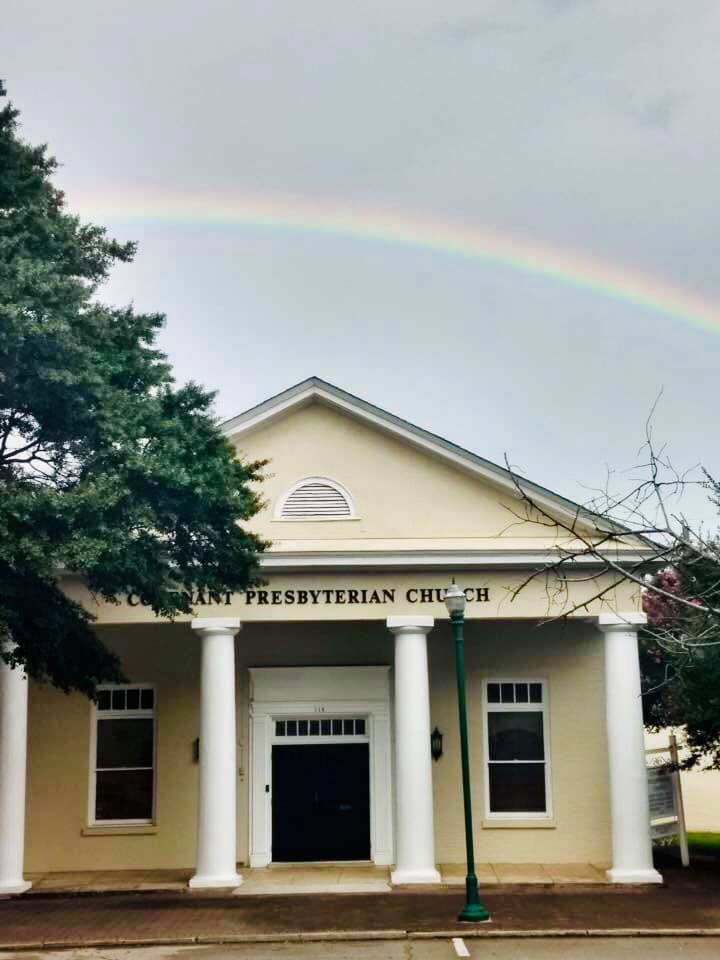
“A symbol of God’s promise made to Noah above our beloved church, Covenant Presbyterian Church (shared by our excellent pastor, A. Boyd Miller IV). Covenant has been our church family for ten years now. I’ve been thinking about how difficult (or impossible) it is to measure what happens when a person or a family roots into a faithful and Bible-believing church. There is no perfect church short of heaven. But nothing replaces the local church in a Christian’s life, and the blessings and power of it are incalculable. I’ve been reflecting on what has kept us grounded as a family over the years, what has kept us faithful to each other and to Christ, what has kept us from absolute despair in dark times, what has uplifted us and provided needed fellowship and accountability throughout the various seasons of our lives. In tandem with the obvious answer of God’s covenant faithfulness, the first thing that came to my mind was being plugged into our local church. Regular Lord’s Day worship. Regular hearing of the preached Word of God. Regular taking of the Lord’s Supper. Regular catechizing of our children. Regular prayer with and for each other as a church body. The Holy Spirit mysteriously and quietly working to center us, convict us of sin, encourage us, tenderize our hearts, point us to our eternal hope and those realities beyond this momentary world, and slowly (or sloooooowly, lol) change us into the likeness of Christ one day at a time. This is what the Lord so graciously provides to His people through the local church. What cause to be grateful and embrace such a gift. Many of our brothers and sisters around the world being imprisoned or martyred for their faith in Christ are literally dying for this privilege that we so often take for granted. If you live in or near LaGrange and haven’t found a church family, then we’d love to have you at Covenant Presbyterian Church! ❤️

“And let us consider how to stir up one another to love and good works, not neglecting to meet together, as is the habit of some, but encouraging one another, and all the more as you see the Day drawing near.” Hebrews 10:24-25

“But as it is, God arranged the members in the body, each one of them, as he chose. If all were a single member, where would the body be? As it is, there are many parts, yet one body. The eye cannot say to the hand, ‘I have no need of you,’ nor again the head to the feet, ‘I have no need of you.’” 1 Corinthians 12:18-21

“Remember the Sabbath Day, to keep it holy.” Exodus 20:8″